What does rotation assessment measure?
Rotation assessment measures the angular offset of a settled toric lens from its intended orientation, and the consistency of that offset.
The lens carries a mark so the offset can be seen. According to Ento Key, Soft Toric Lens Design and Fitting (Contact Lens Practice), those markings may be laser trace, scribe lines, engraved dots or ink dots, and they sit either at the 6 o’clock position or in the horizontal meridian at 3 and 9 o’clock. The mark does not indicate the cylinder axis. It is a reference point and nothing else — how it is read against a slit beam, and how a stable offset is then compensated, are on the Toric Contact Lens Calculator.
Three findings make a complete record:
- Amount — the angle between the mark and its intended position
- Direction — read from the observer’s left and right, not the patient’s
- Stability — whether amount and direction hold across blinks, gaze changes and repeat visits
Only the third is specific to this page, and it is the one most often left out of the note.
When and how do you read rotation?
Read rotation on a settled lens, with the patient upright and in primary gaze, and read it more than once.
The published assessment protocol behind the performance standards below evaluated lenses after 20 minutes of wear (Tan et al 2007, Optometry and Vision Science 84:422–428). Reading a toric lens immediately after insertion reads the insertion.
The sequence is short:
- Let the lens settle. Twenty minutes is the figure the performance study used.
- Sit the patient upright, looking straight ahead. Head tilt and gaze change the reading.
- Find the mark without disturbing the lens. Ento Key notes that markings at 3 and 9 o’clock can be observed without retracting the lower eyelid, which is an advantage precisely because retracting it interferes with the dynamic stabilizing forces that orient the lens. A 6 o’clock mark often requires lid manipulation, and the manipulation itself can move the lens.
- Quantify the offset. Estimation against a clock face is a satisfactory chairside method — there are 30 degrees between each hour — and Ento Key records that errors are more likely when the amount of rotation is large. Alternatively, align a fine slit beam with the marking and read the angle from the rotation scale on the slit lamp light tower, as Contact Lens Spectrum (September 2019) describes.
- Repeat across several blinks and a gaze change, and record whether the value moves.
Two conventions save a re-reading later. Direction is recorded from the examiner’s view, not the patient’s anatomy. And where a laboratory marks at 6 o’clock, many provide three lines separated by the same known angle, which turns an estimate into a comparison.
How do you tell rotation from decentration?
It is the angular orientation of the mark that measures rotation, not where the mark sits on the cornea.
This is the single most useful distinction in the assessment, and it is easy to miss. Ento Key illustrates a soft toric lens on a left eye whose marker appears to indicate about 20 degrees of nasal rotation — until the marker is looked at closely and found to be vertically oriented, which is exactly where it should be. The lens has not rotated at all. It has decentred nasally, carrying its mark with it.
The consequence is practical. Compensating that apparent 20 degrees as if it were rotation orders a lens whose cylinder is genuinely 20 degrees off, and vision gets worse rather than better. Before recording an angle, check the mark’s orientation against vertical or horizontal, then check the lens’s position against the cornea separately.
A decentred lens is a fit finding, not an axis finding. Centration, movement, lag and the push-up test are on Contact Lens Fit Assessment.
What counts as a stable rotation?
Published performance standards call a mean mislocation of ±6 degrees or less excellent, ±7 to ±10 degrees acceptable, and more than ±10 degrees poor.
Those cut-offs come from Tan et al 2007, which set out to standardise the clinical assessment of toric soft lens behaviour. Seven lens designs — four prism ballast, two peri-ballast, one dynamic stabilization — were each worn by groups of 20 subjects. After 20 minutes of wear, right eyes were assessed for comfort, lens mislocation in degrees from vertical, and rotational recovery after a deliberate 30-degree mislocation, expressed as degrees per 10 blinks. Knowing the protocol is what makes the numbers readable.
| Variable | Excellent | Acceptable | Poor |
|---|---|---|---|
| Mean lens mislocation | ≤ ±6° | ±7° to ±10° | > ±10° |
| Variability of orientation (SD) | < ±6° | ±6° to ±10° | > ±10° |
| Rotational recovery per 10 blinks | > 10° | 6° to 10° | < 6° |
| Lenses orienting within ±10° of target | ≥ 90% | 70% to 89% | < 70% |
| Subjective comfort (100-point scale) | ≥ 90 | 80 to 89 | < 80 |
Two readings of that table matter at the chair. The variability row is the stability criterion — a lens that averages 5 degrees but swings across a 20-degree range is not a 5-degree lens. The percentage within ±10° row is a design-level statistic from groups of wearers, not a finding you take from one patient; it describes how a design behaves across eyes.
For context on what is typical rather than what is acceptable: Ento Key reports that soft toric lenses tend to rotate nasally by about 5 to 10 degrees on average, with significant variability between wearers and between designs.
The order of priority is stated plainly in the same chapter: rotational stability is generally a more important factor than the degree of rotation. A lens giving suboptimal but stable acuity is more likely to be accepted than one giving moments of clear vision followed by moments of poor vision as it rotates.
What does misalignment cost in vision?
About one-third of the cylinder power is left uncorrected for every 10 degrees of misalignment.
Contact Lens Spectrum (September 2019) states that figure, citing Jackson (2016), and works it through: a lens carrying −1.75 DC rotated 10 degrees leaves more than 0.50 DC uncorrected, and the uncorrected amount grows with both the cylinder power and the misalignment.
The optics behind it are a crossed-cylinder problem, and the resulting error is not a simple loss of cylinder. Ento Key’s worked figure: a lens of plano/−2.00 DC × 180 mislocated by 10 degrees produces a spherocylindrical error of +0.35/−0.69 DC × 40 — a different power, at a different axis, in a different sign pattern from the one that was ordered.
Three consequences follow:
- Tolerance scales with cylinder. A patient wearing a 1.25 D cylinder may accept 5 degrees of rotation where a patient wearing a 3.50 D cylinder will notice the same 5 degrees as a clear drop in vision.
- Large rotation is worth avoiding even when it is stable. Eyes On Eyecare (Erin Rueff, OD, PhD, 14 December 2023) advises against accepting 15 to 20 degrees or more regardless of stability, and switching to a different stabilization type instead.
- The over-refraction tells you which problem you have. A useful rule of thumb from Ento Key: a lens made to specification but mislocating on the eye produces an over-refraction whose spherical equivalent is zero. When the sphere or cylinder power itself is wrong, the spherical equivalent will not be zero.
Calculate the residual sphere, cylinder and axis on the Over-Refraction Calculator for Contact Lens Parameters once the lens is stable.
What do you change when rotation will not stabilize?
Unstable rotation is a fit change, not an axis change.
The way a lens returns to orientation reads the fit directly. Ento Key sets out three patterns:
- Well-fitting — stable orientation, with a quick return to axis after a deliberate mislocation
- Tight — stable orientation, but a slow return to axis
- Loose — unstable and inconsistent orientation
That list corrects a common instinct. Fitting a toric lens deliberately steep to stop it rotating does not work: a lens too tightly adherent to the eye is not affected by the locating forces designed to stabilize its orientation, and a steep fit can decrease stability while adding limbal indentation and fluctuating vision from apical vaulting.
What changes instead:
- Sagittal depth, through Base Curve of Contact Lenses or Diameter of Contact Lenses where the design allows either to be specified
- The stabilization design — prism ballast (the inferior thickening behind the lay term weighted contacts), peri-ballast, or a thin-zone dynamic stabilization design. Eyes On Eyecare puts it directly: unacceptable rotation usually reflects the patient’s lid and ocular anatomy, so the efficient move is a design that stabilizes differently rather than a struggle with the one in front of you
- Nothing optical, until one of the above has produced a repeatable orientation
As a reference point for the rest of the fit, Ento Key describes a well-fitting soft toric as showing about 0.25 to 0.5 mm of vertical movement on blink in primary position, and lagging no more than 0.5 mm on up-gaze or lateral movement. Movement, centration and lag in full are on Contact Lens Fit Assessment.
Where does the compensation happen?
A stable rotation is compensated by adjusting the ordered cylinder axis — and that adjustment is made on the toric calculator, not here.
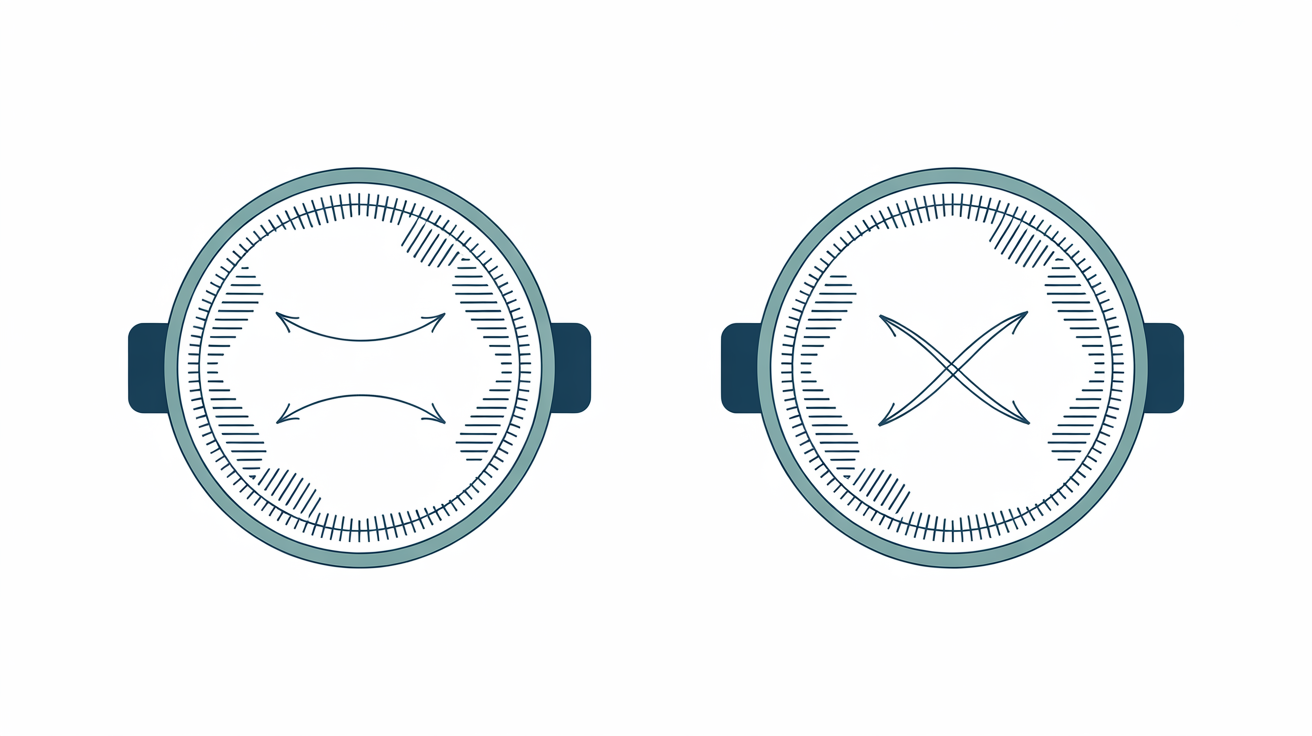
The mnemonic is LARS, Left Add Right Subtract, applied to the axis you order next and only when the rotation repeats. The direction convention, the worked example, the boundary at which a spherical over-refraction stops being sufficient, and the cross-cylinder path all live on the Toric Contact Lens Calculator, which owns that arithmetic across this site.
An unstable rotation is not compensated at all. That is the whole point of assessing stability before reaching for a number: the compensation assumes the next lens will sit the way this one did.
Rotation is read by a practitioner at the slit lamp
Every observation on this page is made by a licensed eye-care practitioner with the lens on the patient’s eye and a slit lamp in front of it.
A wearer cannot see their own orientation mark, cannot judge whether an offset repeats, and cannot distinguish a rotated lens from a decentred one. Fluctuating vision in a toric lens is a finding to bring to a fitter, and the fix is a fitting decision — a different axis, a different geometry, or a different stabilization design.
Patient aside (Grade 8–9)
Lenses for astigmatism have to sit at a particular angle to work, and they carry a tiny mark so your eye doctor can check that angle. If your vision goes in and out of focus through the day, the lens may be turning on your eye. That is worth an appointment — not a different box.
Read Starting Contact Lens Parameters Are Not a Prescription for the bound that applies across this site. Fit a starting toric or multifocal contact lens on eye. Assess rotation and its stability before power. Verify power with over-refraction after the trial lens. Contact lens parameters at the corneal plane stay unfinished until a practitioner completes the fitting and writes the prescription.
Sources
Clinical claims on this page are attributed to the publications below.
- Tan J, Papas E, Carnt N, Jalbert I, Skotnitsky C, Shiobara M, Lum E, Holden B, “Performance standards for toric soft contact lenses”(Optometry and Vision Science 2007;84(5):422–428) — the assessment protocol (seven designs, groups of 20 subjects, 20 minutes of wear, right eyes, mislocation in degrees from vertical, rotational recovery after a deliberate 30° mislocation in degrees per 10 blinks) and every performance cut-off in the table above.
- Ento Key, Soft Toric Lens Design and Fitting(Contact Lens Practice) — mark types and positions; the 3-and-9 argument against retracting the lower lid; the three-line 6 o’clock convention; clock-face estimation at 30 degrees per hour and larger errors at larger rotations; the marker-orientation-versus-marker-position distinction and the decentred-lens illustration; nasal rotation of about 5–10 degrees with wide variability; stability as more important than degree; the well-fitting, tight and loose orientation-recovery patterns; the steep-fit failure mode; 0.25–0.5 mm movement and no more than 0.5 mm lag; the plano/−2.00 DC × 180 mislocated-by-10° error of +0.35/−0.69 DC × 40; the cylinder-dependent tolerance example; the spherical-equivalent-of-zero rule of thumb.
- Contact Lens Spectrum, Take a Turn With Soft Toric Lenses for Astigmatism(September 2019) — slit-beam alignment and the rotation scale on the slit lamp light tower; direction read from the examiner’s view; approximately one-third of cylinder power uncorrected per 10 degrees of misalignment, citing Jackson (2016), with the −1.75 DC worked example; inconsistent rotation requiring a parameter or design change rather than a power change.
- Eyes On Eyecare, Troubleshooting Soft Toric Contact Lenses(Erin Rueff, OD, PhD, FAAO, Dipl. CCLRT, 14 December 2023) — establish whether rotation is stable before any strategy; unstable rotation is not correctable by power; unacceptable rotation usually reflects lid and ocular anatomy, so switch stabilization type; avoid accepting 15–20 degrees or more regardless of stability.
External links are citations, not endorsements. This site is manufacturer-agnostic: advertising is labeled and advertisers do not influence formulas, defaults, or copy. That commitment is set out in the terms of use.
Published Last updated Report a correction