What are RGP contact lens parameters?
RGP contact lens parameters are the ordered base curve, power, and diameter of a rigid gas permeable lens as worn on the cornea.
According to the FDA, Types of Contact Lenses, there are two general categories of contact lenses: soft and rigid gas permeable (RGP). All contact lenses require a valid prescription. Soft lenses are flexible plastics that pass oxygen to the cornea. RGPs are more durable, resist deposits, and generally give clearer vision. They are less comfortable at first. The FDA states adaptation may take a few weeks for RGPs versus several days for soft lenses.
According to the American Optometric Association, Types of Contact Lenses, RGP lenses are slightly flexible plastics that allow oxygen through, with excellent vision listed as an advantage and a short adaptation period. Those two adaptation wordings are not collapsed into one unattributed duration.
The following four values make up the starting GP set this guide covers:
- Base curve in millimeters or diopters, from keratometry
- Ordered sphere after tear-lens and vertex adjustments
- Cylinder and axis when a GP toric or bitoric is indicated
- Overall diameter as a design field a glasses Rx never contained
They are not a soft-lens SKU. According to the ODReference, RGP Lens Calculator, manufacturer fitting guides and slit-lamp findings remain the primary references for design selection, edge profile, diameter, and overall fitting strategy.
What are the steps in RGP lens fitting?
RGP lens fitting runs in a fixed order: keratometry, a starting base curve, the tear lens, then ordered power, proved on eye with fluorescein and over-refraction.
According to ODReference’s suggested RGP workflow, that sequence starts from K readings and an initial base curve, evaluates fit and fluorescein pattern on eye, obtains an over-refraction after the lens settles, then combines K readings, base curve, and over-refraction into the ordered power. According to the GPLI, GP Lens Management Guide, the chairside fitting pearls for that visit are to use diagnostic lenses, apply fluorescein to evaluate the fitting relationship, and put a yellow filter over the observation system of the slit lamp to enhance the pattern.
The following seven steps are the RGP contact lens fitting sequence, and each one is a section below:
- Confirm that a rigid design is indicated rather than a soft lens.
- Record flat K and steep K, and convert the meridians into one unit.
- Select a starting base curve on K, steeper, or flatter as a fitting philosophy.
- Add the tear lens that base curve creates, with SAM or FAP as the sign check.
- Vertex the high meridians and round the ordered sphere to 0.25 D.
- Assess the fluorescein pattern, edge lift, and movement and centration once the lens is on eye.
- Over-refract the settled lens, then re-order power only after the geometry is stable.
Empirical fitting reorders that list; it does not shorten it. According to Review of Contact Lenses, Empirical Fitting of GP Lenses, an empirical design is worked out from refraction and keratometry (often topography) plus a lab nomogram, without diagnostic lenses — so the on-eye steps move to the dispensing visit rather than disappearing. Nothing in this RGP lens fitting guide replaces them, and step 5 is the only step this site runs as arithmetic, on the RGP Contact Lens Power Calculator.
When is a gas permeable lens indicated instead of a soft lens?
A gas permeable lens is indicated for an irregular cornea that a soft lens would drape.
Keratometry measures corneal curvature. Corneal topography maps the surface in three dimensions. An irregular cornea (high astigmatism or keratoconus) is a reason to consider RGP rather than a soft lens. An RGP lens retains its shape on blink. A soft lens conforms to the eye, which is a disadvantage when the cornea is irregular.
The following three findings push the path off a spherical soft conversion:
- Irregular cornea named as high astigmatism or keratoconus
- Soft draping that would copy that irregularity
- Keratometry or topography that sets GP base curve, not a soft 8.x mm picker
That indication is the depth promised from Starting Contact Lens Parameters Are Not a Prescription. GP starting parameters still are not a prescription.
According to Review of Contact Lenses, Empirical Fitting of GP Lenses, empirical fitting means designing without diagnostic lenses from refraction and keratometry (often topography) plus a lab nomogram. That path still starts from K readings. It does not skip on-eye confirmation.
Patient aside (Grade 8 to 9)
Rigid gas permeable lenses are the “hard” lenses the FDA groups opposite soft lenses. They sit on a layer of tears and keep their shape. Only a licensed fitter decides if that design is indicated. Do not order GP lenses from a glasses prescription.
How do you convert keratometry readings to a starting GP base curve?
A starting GP base curve is converted from keratometry by taking the flattest K reading, matching units, then choosing on-K, steeper, or flatter as a fitting philosophy.
Keratometry (a K reading) is the measured curvature of the cornea in diopters or millimeters. Flat K is the flatter principal meridian. Steep K is the steeper meridian. According to Ento Key, Rigid Contact Lenses Basics (Stein et al., Fitting Guide for Rigid and Soft Contact Lenses, 4th ed.), contact lens work usually first considers the flattest K reading.
The following four steps are that conversion, not a lab order:
- Record flat K and steep K from the keratometer or simulated K from topography.
- Convert both meridians into the same unit with D = 337.5 ÷ r (r in millimeters).
- Select an initial base curve relative to flat K (on K, steeper, or flatter).
- Confirm the trial on eye with fluorescein before locking the ordered curve.
Those four steps answer how to calculate base curve from a K reading for an RGP. They are not how to pick a soft 8.5 versus 9.0. Soft base curve remains a different entity on Base Curve of Contact Lenses. This URL does not output peripheral curves or optical zone: the full back-surface specification is defined on GP Contact Lens Design: Zones, Curves, and Edge Lift, and the curve system that produces edge lift on Peripheral Curves and Edge Lift of GP Contact Lenses.
How does millimeter-to-diopter conversion work for K readings?
Keratometry millimeters and diopters convert with D = 337.5 ÷ r, using the keratometric index 1.3375.
Formula block
D = 337.5 ÷ r and r = 337.5 ÷ D
D is equivalent corneal power in diopters. r is anterior radius in millimeters. The constant 337.5 is the standardized keratometric refractive index 1.3375 expressed for r in millimeters. According to the ODReference, MM to Diopter Conversion Calculator, this convention produces SimK-style values used for contact lens fitting and ordering. The same 1.3375 index is the keratometric convention described in Wikipedia, Intraocular lens power calculation.
A shorter radius is a steeper cornea and a higher dioptric value. A longer radius is a flatter cornea and a lower dioptric value. Around typical corneal radii, 0.10 mm corresponds to roughly 0.50 D of curvature change on that same ODReference radius page.
The following table shows common K values converted with r = 337.5 ÷ D, rounded to two decimals. Cells are recomputed from the formula. They are not pasted from GPLI or ODReference charts. The GPLI, Conversion Charts independently list 45.00 D → 7.50 mm, which matches the first row.
| K reading (D) | Radius (mm) |
|---|---|
| 45.00 | 7.50 |
| 44.50 | 7.58 |
| 44.00 | 7.67 |
| 43.00 | 7.85 |
| 42.00 | 8.04 |
Those five pairs are a chairside lookup, not a GP design calculator. Art Optical, Diopter-Radius Conversion converts the same two units as a lab tool; this table stays on the 1.3375 convention only.
For a K reading this keratometry conversion chart does not list, run the mm to diopter conversion on the RGP Contact Lens Power Calculator, which implements the same D = 337.5 ÷ r in both directions before it takes the tear lens.
Is the starting GP base curve on K, steeper, or flatter?
Starting GP base curve may be on K, steeper than K, or flatter than K; this site does not pick one nomogram as an engine.
According to the same Ento Key page, if the back surface of the lens is the same radius as K, that is fitting on K. For K readings 44.50/45.00, the on-K base curve is 44.50 D or 7.58 mm. RGP lenses may be fitted on K, flatter than K, or steeper than K, depending on lens size and corneal astigmatism.
According to Contact Lens Spectrum, Rules of Thumb (Tony A.J. Phillips and Kristin Bailey, October 2024), two commonly used rules of thumb in GP practice are: choose an initial back optic zone radius (BOZR) 0.10 mm steeper than the flattest K reading; and a 0.50 mm change in back optic zone diameter (BOZD) historically required a 0.05 mm BOZR change to keep the same central fluorescein pattern. That article states both rules are only partially correct and are guides, not scientifically exact engines.
According to Opterio, Base Curve Selection for Contact Lenses, an alignment starting point is often 0.50 to 1.00 D flatter than flat K (or 0.05 to 0.10 mm flatter). That page’s steep fit is on flat K or up to 0.50 D steeper. Those numbers are that author’s fitting philosophy. They are not Contact Lens Calc’s calculator.
Takeaway: convert the K reading to a radius, then choose a philosophy and prove it with fluorescein. Do not treat “0.10 mm steeper” or “0.50 D flatter” as this site’s engine.
How does the tear lens change ordered GP power?
The tear lens changes ordered GP power by about base curve in diopters minus flat K.
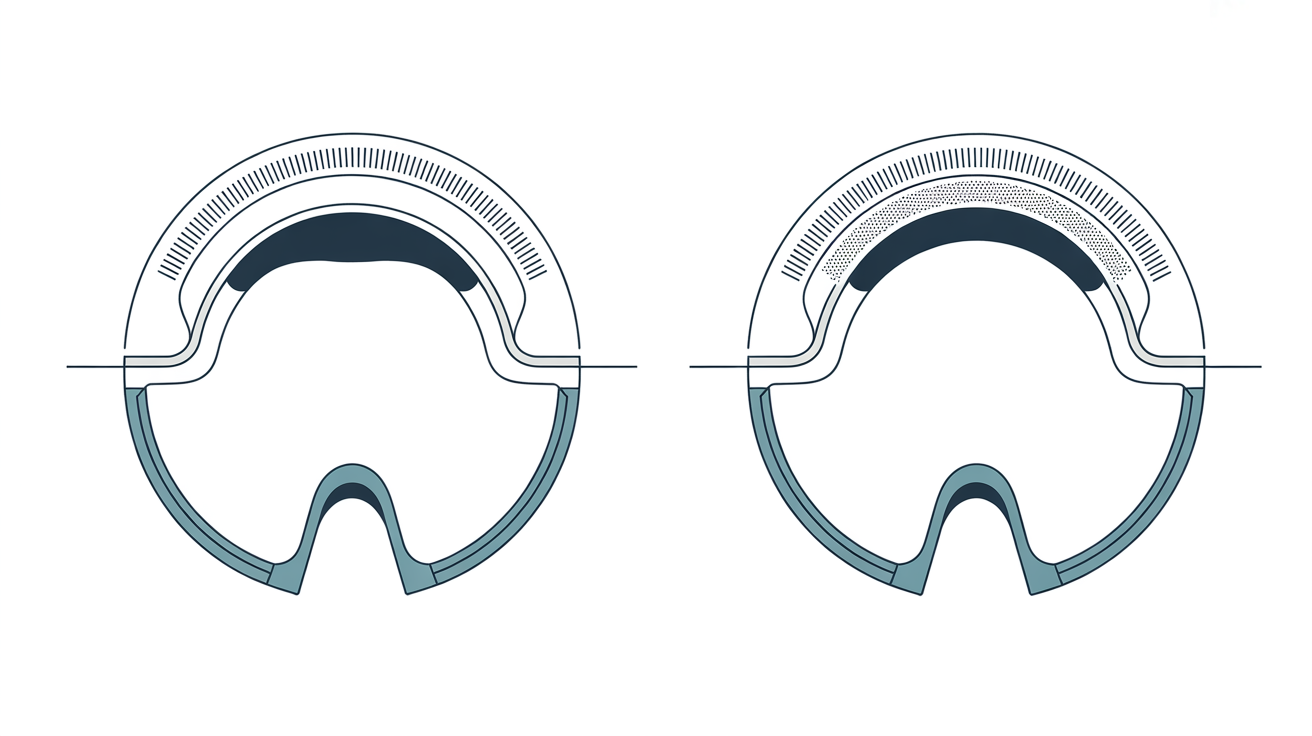
According to the ODReference, RGP Lens Calculator, RGP lenses retain their shape instead of draping over the cornea. The space between the back surface of the lens and the anterior cornea fills with tears and forms a tear lens with real refractive power. Ento Key calls that interface a fluid lens. If the back surface radius matches the front surface of the cornea, that fluid lens is zero.
The following three signs are that tear lens:
- Lens steeper than the cornea (BC smaller in mm than K): tear lens acts as plus
- Lens flatter than the cornea (BC larger in mm than K): tear lens acts as minus
- Lens on K: tear-lens power about zero before residual cylinder is considered
According to ODReference, tear lens (D) ≈ base curve (D) − flat K (D). Example: flat K 44.00 D and selected base curve 45.00 D give a tear lens of about +1.00 D. If you change the base curve after assessing fit, the tear lens changes too. Ordered power must change to keep the same net optical result.
Tear lens power is that subtraction and nothing more. Calculate it alongside the ordered sphere on the RGP Contact Lens Power Calculator; this page keeps why the sign moves.
What do SAM and FAP mean when the base curve changes?
SAM means Steeper Add Minus and FAP means Flatter Add Plus when GP base curve changes.
According to ODReference, steepening the base curve creates more plus tear-lens power, so you add minus to the ordered lens power. Flattening the base curve creates more minus tear-lens power, so you add plus. Around typical corneal curvatures, a 0.10 mm base curve change is often close to 0.50 D of tear-lens change.
Worked SAM: ordered power −3.00 D at 8.00 mm BC. New BC 7.90 mm is 0.10 mm steeper, about 0.50 D. New starting power is −3.50 D. Those step sizes match the first example on Opterio’s base-curve page; the 1:1 diopter match is the ODReference tear-lens formula.
Worked FAP: ordered power −2.50 D at 42.00 D BC. New BC 41.50 D is 0.50 D flatter. New starting power is −2.00 D.
Opterio notes some sources use a 0.50:1 or 0.75:1 ratio and treats 1:1 as common for examination questions. This page uses the tear-lens subtraction in diopters, then the 0.10 mm ≈ 0.50 D chairside approximation from ODReference.
When diameter changes with base curve, ODReference states to flatten by about 0.05 mm (0.25 D) for every 0.4 mm increase in diameter to keep a similar sagittal relationship, then apply SAM-FAP. Contact Lens Spectrum’s later BOZD note uses 0.10 mm to 0.15 mm BOZR per 0.50 mm BOZD for an average corneal eccentricity. Those two sag rules are not merged into one number here.
How do you calculate starting RGP lens power from the spectacle refraction?
Starting RGP lens power is calculated as corneal-plane spectacle power combined with the tear lens, then rounded to 0.25 D.
According to the GPLI, Toric and Spherical Lens Calculator, powers are vertexed to the corneal plane. This site’s vertex gate remains meridians of about ±4.00 D, with default vertex 12 mm when unspecified. The GPLI, Conversion Charts vertex column starts at 4.00. That chart does not disclose vertex distance in millimeters, so 12 mm is not attributed to GPLI. Isolate that compensation on the Contact Lens Vertex Calculator and Distance Chart.
The following four steps calculate starting GP power:
- Vertex each spectacle meridian at or above about ±4.00 D.
- Convert the selected base curve and flat K into diopters if they were entered in millimeters.
- Add the tear lens (BC in D minus flat K) with SAM or FAP as the sign check.
- Round the ordered sphere to the nearest 0.25 D.
GPLI lets the user round diopters to 0.25 or 0.01. Contact Lens Calc keeps 0.25 D as the manufacturing step used elsewhere on this site. The result is starting power for a diagnostic GP.
Those four steps run as arithmetic on theRGP Contact Lens Power Calculator, which converts the refraction, subtracts the tear lens, and rounds. This guide keeps the fitting method — base curve selection, edge lift, peripheral curves, fluorescein, and the bitoric threshold; that URL takes the number.
When does a spherical GP become a toric or bitoric RGP design?
A spherical GP becomes a toric or bitoric RGP design when corneal cylinder is above about 2 D and the tear lens cannot finish the cylinder.
According to GPLI, Spherical GP Contact Lenses, the spherical GP nomogram is a dynamic empirical method for patients with ≤2 D of corneal cylinder. For >2 D of corneal astigmatism, a GP toric lens is recommended, with toric powers, base curve radii, and overall diameter provided via on-eye optical crosses.
According to ODReference, a spherical RGP can typically neutralize up to about 2.00 D of with-the-rule corneal astigmatism through the tear lens alone. Beyond that, residual astigmatism appears in the over-refraction. A bitoric RGP — toricity on the back surface, plus front-surface cylinder where it is still needed — is often considered around 2.00 to 2.50 D or more of corneal toricity.
The following table compares those sourced thresholds. It is not an Art Optical Single / Bi Toric / Back Toric output.
| Design class | Sourced corneal-cylinder note | Tear-lens role |
|---|---|---|
| Spherical GP | GPLI ≤2 D; ODReference about 2.00 D WTR | Tear film fills a spherical back surface over a toric cornea |
| GP toric | GPLI >2 D corneal astigmatism | Toric radii and powers from on-eye optical crosses |
| Bitoric | ODReference often 2.00 to 2.50 D or more of corneal toricity | Back-surface toricity plus any remaining front-surface cylinder |
GPLI’s toric diameter picker and ODReference’s toric diameter picker both list 8.0–8.6 mm, 8.7–9.3 mm, and 9.4–10.2 mm (GPLI marks 8.0–8.6 mm torics only). Those bands are typical overall-diameter groups on those tools. They are not an order from this page.
Art Optical, Standard Lens Design Calculator returns Single, Bi Toric, or Back Toric parameters, including optical zone, and can require a consultation when a front-toric is needed or limits are exceeded. This guide does not clone those outputs. Residual-error math after a toric GP trial belongs with over-refraction, not a second nomogram here.
Which designs make a multifocal RGP lens?
RGP multifocal contact lenses generate the add in one of three geometries: aspheric, concentric, or translating (segmented).
According to Review of Contact Lenses, Freedom on Your Fingertip (Cory Collier, OD, March 2018), multifocal corneal GP lenses are available in translating, concentric, and aspheric designs. Which geometry is ordered is a design decision, and it is a different decision from the add itself: the design settles how the lens must sit and blink, while the spectacle add converts to a starting add on the Multifocal Contact Lens Calculator.
| Design | How the add is generated | What the fit depends on |
|---|---|---|
| Aspheric | Curvature changes gradually along the front or back surface, giving plus power toward the periphery | Centration over the pupil; a back-surface aspheric carries the add on the same curvature that sets the fitting relationship |
| Concentric | Distinct distance and near rings, alternating from the center outward | Pupil size against the ring geometry; both powers are present at once |
| Translating (segmented) | A distance zone with a separate near segment, as on a bifocal spectacle lens | Lower lid position and tension; the lens has to be held and pushed up on downgaze |
According to Contact Lens Spectrum, Corneal GP Multifocal Fitting and Troubleshooting (John Mark Jackson, OD, MS, FAAO, and Yueren Wang, OD, June 2020), aspheric corneal GPs gradually change curvature along the anterior or posterior surface of the lens, resulting in plus power toward the periphery. Translating, or alternating, designs in the same article carry a distance zone and a near add segment much like a bifocal spectacle lens, and are prism ballasted so the near zone rotates toward the bottom on eye. The segment styles that article names are executive, crescent, and concentric.
Translating designs are the class with an anatomical entry condition. That article lists the desirable traits as a superior lid that slightly covers the upper cornea, a lower eyelid within 1 mm below and 1.5 mm above the lower limbus, and tight lower lid tension, and it notes that any pupil size or a decentered corneal apex can still be fitted. Review of Contact Lenses states a different band for the same requirement — an upper lid near or above the superior limbus, with the lower lid 1 mm to 2 mm above the inferior limbus. Both are reported. They are not averaged into one number.
None of that geometry is an arithmetic step. Distance power is still corneal-plane sphere minus the tear lens on the RGP Contact Lens Power Calculator, and the starting add still converts from the spectacle add on the Multifocal Contact Lens Calculator, which owns that number for rigid and soft designs alike. This guide owns the GP multifocal design question — which geometry, and what each one asks of the lids and the pupil. Segment height, dominance, and the add that is finally ordered are read on eye by a licensed fitter, so a multifocal RGP worked out from keratometry and a spectacle Rx is a starting parameter set and nothing more.
What do peripheral curves and edge lift do on a GP lens?
Peripheral curves are the flatter curves outside the optic zone, and the clearance they open at the lens edge is edge lift.
According to the same Ento Key chapter, most rigid corneal lenses are bicurve or tricurve. A bicurve lens has one base curve and one flatter peripheral curve; a multicurve lens has a base curve and three or more peripheral curves. On the standard tricurve described there, the peripheral curves are 0.4 to 0.8 mm flatter than the base curve with a width of about 1.3 mm, the intermediate curve is 1 mm flatter than the base curve, and the peripheral curve is a standard 12.25 mm radius. The blend is the transition between two adjacent radii, cut with a tool whose radius falls between them.
That chapter also states the optic zone is the lens diameter minus the width of the peripheral curves, and that those curves exist to allow tear flow under the lens at the flatter corneal periphery. Overall diameter and optic zone as ordered fields are defined on Diameter of Contact Lenses.
Edge lift is what the flattening buys. According to Contact Lens Spectrum, Elevate Your Ortho-K Fitting to the Next Level (Gidosh, Morgan, and Norman, December 2017), typical GP lenses have flatter peripheral curves to achieve edge lift and allow tear exchange under the lens. The failure mode in that article is a decentred lens: a superiorly decentred lens shows excessive inferior edge lift and a variable pattern.
Peripheral curve widths and edge-lift systems are lab design fields. This guide names them and reads them on eye; it does not output them. The Contact Lens Spectrum BOZD note above stays the only peripheral geometry quantified here, and it is a rule of thumb, not an engine.
What does the fluorescein pattern show about GP fit?
A fluorescein pattern shows the lens-to-cornea fitting relationship as alignment, apical clearance, or apical bearing.
According to the GPLI, GP Lens Management Guide, the target is an alignment (“even”) pattern — which is not necessarily the same as an on-K base curve selection, because the cornea is aspheric. An apical clearance pattern reflects a steep fitting relationship and can cause peripheral sealoff, poor tear exchange, and possibly adherence. An apical bearing pattern reflects a flat fitting relationship and can end in corneal distortion in the region of bearing. Excessive clearance in any region can trap bubbles between lens and cornea, seen as dimple veiling.
| Fluorescein pattern | Fitting relationship | Sourced change |
|---|---|---|
| Alignment (“even”) | The target relationship | None; not necessarily an on-K base curve |
| Apical clearance | Steep; sealoff, poor tear exchange, possible adherence | Select a flatter base curve radius |
| Apical bearing | Flat; corneal distortion in the region of bearing | Select a steeper base curve radius |
Read that table as fit assessment only. Fluorescein here reads the tear layer under a rigid lens — it is not corneal staining grading, and this page does not interpret epithelial disruption, hypoxic change, or ocular disease. Those findings are a slit-lamp examination, and they stay with the fitter described on Starting Contact Lens Parameters Are Not a Prescription.
Every base curve change made off a fluorescein pattern moves the tear lens, so re-apply SAM or FAP to the ordered power before ordering again. Movement, centration, and lag are the other half of the same visit and are covered on Contact Lens Fit Assessment: Movement, Centration, and Lag.
How is a GP lens verified against the ordered parameters?
A finished GP lens is verified on the bench with a radiuscope, which measures the base curve radius the laboratory actually cut. The same bench sequence applied to soft and GP lenses alike is on Bench Checks of Contact Lens Parameters: Radius and Power.
According to Ento Key, Verification of Gas-Permeable Lenses (Vinita Allee Henry, Clinical Manual of Contact Lenses), the base curve radius (BCR) is one of the most important parameters to verify because it affects the lens-to-cornea fitting relationship, and the most commonly used method of determining it is the radiuscope or radiusgauge. The instrument reads the BCR from the distance between the real and aerial images of a spoke target, on a millimeter scale to the nearest hundredth — a typical result is recorded as 8.20 mm. That chapter also notes several automated keratometers have been found to measure GP base curve radius within tolerance.
The following four checks are lens verification, not fit assessment:
- Base curve radius before dispensing, and again after 12 to 24 hours of soaking in an approved disinfecting solution, because GP lenses may flatten on hydration
- Front (convex) curve radius when the design is a front toric or bitoric
- Toricity or warpage: the spokes do not focus together — one set focuses at the steeper curve, the set 90 degrees away at the flatter
- Center and edge thickness on a dial gauge
The same chapter separates warpage from flexure: a flexing lens can look warped immediately on removal and return to its spherical state soon after, and either can produce blur with a spherocylindrical over-refraction. Verify the base curve radius before treating that as a power problem. A peripheral curve radius can be read the same way only when it is at least 1 mm wide, so peripheral curves are typically not a parameter the practitioner verifies.
This section names the instrument and the parameter it measures. It is not an instrument review and not a purchasing guide. Verification is also where the unit conversion runs backwards: a verified 8.20 mm reads as 41.16 D through D = 337.5 ÷ r, the same step the RGP Contact Lens Power Calculator takes before the tear lens.
How is GP starting power verified with over-refraction?
GP starting power is verified by measuring residual refraction through the trial lens after the fit is stable.
According to ODReference’s suggested RGP workflow, start from K readings and select an initial base curve, evaluate fit and fluorescein pattern on eye, obtain an over-refraction after the lens settles, then combine K readings, base curve, and over-refraction to estimate the ordered power that preserves the net optical result. Re-check vision and fit at follow-up.
The following five steps are that verify path:
- Confirm centration and fluorescein before chasing power.
- Let the GP settle, then measure spherical or spherocylindrical over-refraction.
- Vertex a high-power over-refraction the same way other meridians are vertexed.
- Combine residual error with the lens in use, including any SAM-FAP from a BC change.
- Order the next diagnostic power only after the geometry is stable.
Unstable rock or a dumbbell fluorescein pattern is a design problem first. According to ODReference, that pattern appears when spherical GP cannot finish the cylinder. Calculate residual error on the Over-Refraction Calculator for Contact Lens Parameters.
Which curves define an ortho-k lens design?
An ortho-k lens design is a GP lens in reverse geometry: back optic zone, a steeper reverse curve, an alignment zone, then peripheral curves.
An orthokeratology (ortho-k) lens is a rigid gas permeable lens, so it is described with the curves and units already on this page, with the second curve inverted. According to Contact Lens Spectrum, Elevate Your Ortho-K Fitting to the Next Level, these designs are built from zones that either provide treatment or stabilize the lens. The optic zone is commonly around 6 mm in diameter. Just outside it, the reverse curve generates the tear reservoir and is usually about 3.00 D steeper than the back optic zone radius over a width of 0.50 to 1.00 mm. The alignment zone sits in close alignment with the peripheral cornea at about 0.70 to 1.00 mm wide. The outermost peripheral curve system carries the flattest curves, about 0.50 mm wide, and provides the edge lift.
The pattern that geometry produces is a bull’s-eye with apparent central bearing, though that article notes a thin tear layer remains at the apex — between 5 and 15 microns of clearance is usually acceptable. Compare that with the bicurve and tricurve corneal GP above, where every peripheral curve is flatter than the base curve. Same instruments, same units, one inverted curve.
What is the Jessen factor, or compression factor?
The Jessen factor is the amount a back optic zone radius is flattened relative to flat K; the compression factor is the extra flattening added on top of it.
According to Contact Lens Spectrum, The Jessen and Compression Factor — A Historical Review (Craig W. Norman, February 2024), George Jessen described a process he called “orthofocus” in 1962: a lens whose base curve, or back optic zone radius (BOZR), is fitted flatter than the flat K reading by the amount of myopia targeted for temporary reduction. A −3.00 D myope with K readings of 43.00 @ 180 and 43.25 @ 90 would take a base curve of 40.00 D. That became the Jessen Factor. The later compression factor adds a typical further 0.75 D of BOZR flattening, which puts the same patient at 39.25 D.
Formula block
BOZR = flattest K − (target reduction + 0.75 D)
That is the form Contact Lens Spectrum publishes for the compression factor. The same article records a disagreement rather than settling it: some work argues 0.75 D underestimates the result and that the figure should be 1.75 D or more flatter than flat K, and it closes by saying there is still much to be learned about what the proper formula is. Contact Lens Calc does not run this as a calculator, for the same reason it does not run a GP base curve nomogram.
Not a Rx
Lens geometry only
This section covers ortho-k curves and their units because an ortho-k lens is a GP lens. Candidacy, wearing schedule, corneal-response monitoring, and myopia-management outcomes are clinical care, not ordered lens parameters, and they are not covered on this site at all. Reading the treatment zone back off the post-wear map is on Ortho-K Lens Design and Post-Wear Topography.
How is this guide different from GPLI and Art Optical calculators?
This guide is an independent explainer of starting RGP parameters, not a GPLI or Art Optical lens-design calculator.
GPLI, Art Optical, and ODReference each publish a GP calculator. This URL does not impersonate those tools.
The following table states what those calculators output versus what Contact Lens Calc covers here.
| Tool | What it outputs | What this page does |
|---|---|---|
| GPLI Toric and Spherical Lens Calculator | Bennett spherical nomogram + Quinn GP toric; Ks and refraction in; BCR, OAD, peripheral curves, tear-lens crosses out | Cite ≤2 D / >2 D and starting-point honesty. No PC/OAD engine |
| Art Optical Standard Lens Design | Single, Bi Toric, Back Toric; optical zone; consultation when limits are exceeded | Name as a lab design calculator. No OZ or dual-BC output |
| ODReference RGP Lens Calculator | Tear lens, SAM/FAP, ordered power from Ks, BC, and over-refraction | Match those optics in prose. Stay manufacturer-agnostic |
Contact Lens Calc /guides/rgp | This explainer | Convert Ks and spectacle power into starting parameters in copy, then send verify and vertex to other URLs |
Scleral and hybrid design systems are a different entity. A scleral lens vaults the cornea and lands on conjunctiva, so it is specified by sagittal depth over a chord rather than by a base curve matched to flat K — the boundary is geometric, not editorial. That geometry is defined on Sagittal Depth of Contact Lenses, its zones on Scleral Lens Parameters: Zones, Vault, and Landing, and the GP-centre-plus-soft-skirt construction on Hybrid Contact Lens Design: GP Center and Soft Skirt. This page does not farm those calculators. Mandell-Moore lives on GPLI as a separate bitoric tool and is not cloned here.
What should you convert on a soft-lens calculator instead?
Soft spectacle-to-contact conversion belongs on the Contact Lens Conversion Calculator, not on this RGP guide.
Vertex-compensated soft sphere, optional spherical equivalent, and toric soft starting cylinder are corneal-plane contact lens parameters without a GP tear lens. Ento Key notes that soft contact lenses are generally fitted 3.00 to 5.00 D flatter than K, which is a different relationship than GP on-K / steeper / flatter. Do not use this page to pick a soft 8.x mm base curve.
Convert a glasses Rx into starting soft contact lens parameters on the Contact Lens Conversion Calculator. Soft power, base curve, and diameter as a set are ordered contact lens parameters. Calculate vertex-compensated contact lens power when meridians are high. Fit a starting toric or multifocal contact lens only when that design is indicated. For GP, calculate starting base curve and power from keratometry, then verify power with over-refraction after the trial lens. Starting RGP contact lens parameters remain contact lens parameters at the corneal plane. They are still not a prescription.
Not a Rx
Not a prescription / on-eye next step
Next step for GP is trial lens, fluorescein, then over-refraction. Next step for a soft glasses Rx is the conversion calculator, then a licensed fitting.
Sources
Clinical claims on this page are attributed to the publications below.
- FDA, Types of Contact Lenses— two categories, soft and RGP; all require a valid prescription; RGP durability, clearer vision, few weeks versus several days for soft.
- American Optometric Association, Types of Contact Lenses— RGP slightly flexible oxygen-permeable plastics; excellent vision; short adaptation period (not merged with FDA weeks).
- ODReference, RGP Lens Calculator— tear lens plus/minus; SAM/FAP; tear lens ≈ BC(D) − flat K; example 44.00/45.00 → +1.00 D; 0.10 mm ≈ 0.50 D; about 2.00 D WTR spherical; bitoric often 2.00–2.50 D+; 0.05 mm (0.25 D) per 0.4 mm diameter; five-step workflow; manufacturer guides remain primary; diameter bands 8.0–8.6 / 8.7–9.3 / 9.4–10.2.
- ODReference, MM to Diopter Conversion Calculator— n = 1.3375; D = 337.5 ÷ r; 7.50 mm = 45.00 D; 43.00 D ≈ 7.85 mm; 0.10 mm ≈ 0.50 D.
- Wikipedia, Intraocular lens power calculation— keratometric index 1.3375 used in the D = 337.5 ÷ r convention.
- GPLI, Toric and Spherical Lens Calculator— Bennett + Quinn; ≤2 D spherical / >2 D toric; round 0.25 or 0.01; no first-fit guarantee; starting point; diameter bands; powers vertexed to the corneal plane.
- GPLI, Spherical GP Contact Lenses— spherical GP nomogram for patients with ≤2 D of corneal cylinder.
- GPLI, Conversion Charts— 45.00 D = 7.50 mm; vertex column starts at 4.00; vertex distance in millimeters not disclosed.
- GPLI, GP Lens Management Guide — Spherical GP Fitting and Problem-Solving— fitting pearls: diagnostic lenses, fluorescein to evaluate the fitting relationship, yellow filter over the observation system; alignment (“even”) pattern as the target and not necessarily on K; apical clearance = steep, sealoff, poor tear exchange, possible adherence → flatter BCR; apical bearing = flat, corneal distortion → steeper BCR; excessive clearance → trapped bubbles, dimple veiling.
- Art Optical, Standard Lens Design Calculator— Ks, power, cylinder, axis in; Single / Bi Toric / Back Toric; optical zone; front-toric consult; design limitations.
- Art Optical, Diopter-Radius Conversion— radius ↔ diopter lab tool.
- Contact Lens Spectrum, Rules of Thumb— Phillips and Bailey, October 2024; 0.10 mm steeper than flattest K only partially correct; 0.50 mm BOZD / 0.05 mm BOZR historical pair; later 0.10–0.15 mm BOZR per 0.50 mm BOZD; rules of thumb not scientifically exact.
- Contact Lens Spectrum, Elevate Your Ortho-K Fitting to the Next Level— Gidosh, Morgan, and Norman, December 2017; typical GP lenses use flatter peripheral curves to achieve edge lift and tear exchange; reverse-geometry zones — optic zone about 6 mm, reverse curve about 3.00 D steeper over 0.50–1.00 mm, alignment zone 0.70–1.00 mm, peripheral curve system about 0.50 mm; bull’s-eye pattern with 5–15 microns of apical clearance; decentred lens shows excessive edge lift on one side.
- Contact Lens Spectrum, The Jessen and Compression Factor — A Historical Review— Craig W. Norman, February 2024; Jessen’s 1962 “orthofocus”; BOZR flatter than flat K by the targeted reduction; −3.00 D with 43.00/43.25 → 40.00 D, and 39.25 D with the compression factor; BOZR = flattest K − (target reduction + 0.75 D); 1.75 D argued elsewhere; proper formula still unsettled.
- Contact Lens Spectrum, Corneal GP Multifocal Fitting and Troubleshooting— John Mark Jackson, OD, MS, FAAO, and Yueren Wang, OD, June 2020; aspheric corneal GPs change curvature along the anterior or posterior surface for plus power toward the periphery; translating (alternating) designs as a distance zone plus a near add segment, prism ballasted so the near zone rotates to the bottom; executive, crescent and concentric segment styles; desirable anatomy of a superior lid slightly covering the upper cornea, a lower eyelid within 1 mm below and 1.5 mm above the lower limbus, and tight lower lid tension; any pupil size or a decentered corneal apex can be fitted.
- Opterio, Base Curve Selection for Contact Lenses— D = 337.5 / mm; alignment 0.50–1.00 D flatter than flat K; SAM/FAP 1:1 with note of other ratios; worked 8.00→7.90 mm and 42.00→41.50 D examples.
- Ento Key, Rigid Contact Lenses Basics— flattest K first; on K 44.50/45.00 → 44.50 D or 7.58 mm; on K / flatter / steeper; fluid lens zero when radii match; soft generally 3.00 to 5.00 D flatter than K; bicurve and tricurve designs, peripheral curves 0.4–0.8 mm flatter than base curve at about 1.3 mm wide, intermediate curve 1 mm flatter, standard 12.25 mm peripheral radius, blend definition, optic zone = diameter minus peripheral curve widths.
- Ento Key, Verification of Gas-Permeable Lenses— Vinita Allee Henry, Clinical Manual of Contact Lenses; BCR most important parameter to verify; radiuscope or radiusgauge as the usual method; real versus aerial image; millimeter scale to the nearest hundredth, e.g. 8.20 mm; re-verify after 12–24 hours of soaking because GP lenses may flatten on hydration; front curve radius for front torics and bitorics; warped lens spokes focus 90 degrees apart; flexure versus warpage; peripheral curve radius readable only at ≥1 mm width; thickness on a dial gauge.
- Review of Contact Lenses, Empirical Fitting of GP Lenses— empirical = without diagnostic lenses; refraction + Ks / topography / nomograms.
- Review of Contact Lenses, Freedom on Your Fingertip: GP, Hybrid and Scleral Multifocals— Cory Collier, OD, March 2018; multifocal corneal GP lenses available in translating, concentric and aspheric designs; aspheric power gradient inside the optic zone carrying distance, intermediate and near optics; concentric distance and near rings as simultaneous vision; upper lid near or above the superior limbus with the lower lid 1 mm to 2 mm above the inferior limbus.
Published Last updated Report a correction