What does axis mean for contact lenses?
Axis is the meridian along which a toric lens places its cylinder, stated in degrees.
A cylinder correction is directional. It works along one meridian of the eye and not along the one ninety degrees away, so the lens has to know which meridian to work along. The axis is that instruction. It appears only alongside a cylinder, only on toric lenses, and it carries no power of its own — read what CYL means for the magnitude half of the pair.
The convention runs anticlockwise from the horizontal as seen by the person looking at the eye: 180 is horizontal, 090 is vertical, and the numbers in between are the meridians between them. The value describes the eye, not the lens sitting in front of it, which is why the same axis is written for glasses and for contacts even though the two corrections sit at different distances.
Axis is the reason a toric lens is a mechanically harder object than a spherical one. A spherical lens works the same whichever way up it lands. A toric lens has one correct orientation, and the whole design exists to hold it there.
How is axis written?
Axis is written as three digits from 001 to 180, without a unit.
- The scale is a half-circle, not a full one. A cylinder axis names a line, and a line repeats every 180 degrees — a meridian at 200 degrees is the same line as one at 020. So the range stops at 180 and starts again.
- The horizontal is written 180, not 000. Both describe the same meridian; 180 is the convention, and a written 000 is usually a transcription slip.
- The degree symbol is normally dropped on lens orders. A bare 090 is ninety degrees.
- An axis outside 001–180 is an error, not a new meridian. Chadwick Optical and ODReference both wrap axis values back into that range for exactly this reason. A value of 190 on a form needs correcting at source, not interpreting.
- Leading zeros are padding, not precision. 010 and 10 are the same meridian; the three-digit form exists so a handwritten 10 cannot be read as 100.
Is axis 010 the same as 180? Is 170 the same as 180?
No to both. They are different meridians, and in both cases the difference is 10 degrees.
The half-circle scale is what makes this counter-intuitive. On a 0–180 line, 010 looks close to 000 and far from 180 — but 000 and 180 are the same meridian, so 010 is 10 degrees from 180, not 170 degrees from it. Likewise 170 is 10 degrees from 180 on the other side. The two comparisons in the heading are the same question asked from opposite ends, and both have the same answer: adjacent meridians, ten degrees apart.
Whether ten degrees matters depends on the cylinder it is carrying. A small cylinder placed slightly off-meridian degrades vision slightly. A large one placed off-meridian degrades it a great deal, and does so by introducing error rather than by correcting less — the misplaced cylinder adds an astigmatic component of its own. That is why axis accuracy becomes more important as cylinder rises, and why a toric fitting is judged on where the lens actually sits and not only on what was ordered.
One question this page does not answer is whether a higher axis number is better or worse. It is neither, and the question has no version that can be answered: an axis is a location, not a quantity. An eye with an axis of 175 is not more or less corrected than one with an axis of 005 — the two eyes are simply astigmatic along meridians that happen to be adjacent to each other. What your axis means for your eyes is a question for the practitioner who measured it.
Does the axis change when a spectacle Rx is converted?
No. Vertex compensation changes power. It does not change orientation.
Moving a correction from the spectacle plane to the corneal plane alters how many diopters are needed. It does not rotate the eye, and it does not rotate the meridian the astigmatism sits on. So when a spectacle refraction is converted to starting contact lens parameters, the sphere moves, the cylinder moves — because each principal meridian is compensated separately and the two move by different amounts — and the axis is carried across unchanged.
That single fact removes a common source of error: an axis that differs between a glasses prescription and a contact lens order was changed by something else, not by the conversion. Calculate the powers on the Toric Contact Lens Calculator or the Contact Lens Conversion Calculator; read vertex-compensated contact lens power for why the powers move at all, and is power the same as sphere for the sphere half of the same argument.
When does the axis change on paper?
When the refraction is transposed between plus-cylinder and minus-cylinder form.
Transposition rewrites one refraction as the other, and it moves three values together: the sphere becomes sphere plus cylinder, the cylinder sign reverses, and the axis rotates 90 degrees. According to ODReference, Plus/Minus Cylinder Conversion, the rotation wraps into range — add 90 when the original axis is 90 or less, subtract 90 when it is greater — and Chadwick Optical uses the same wrap.
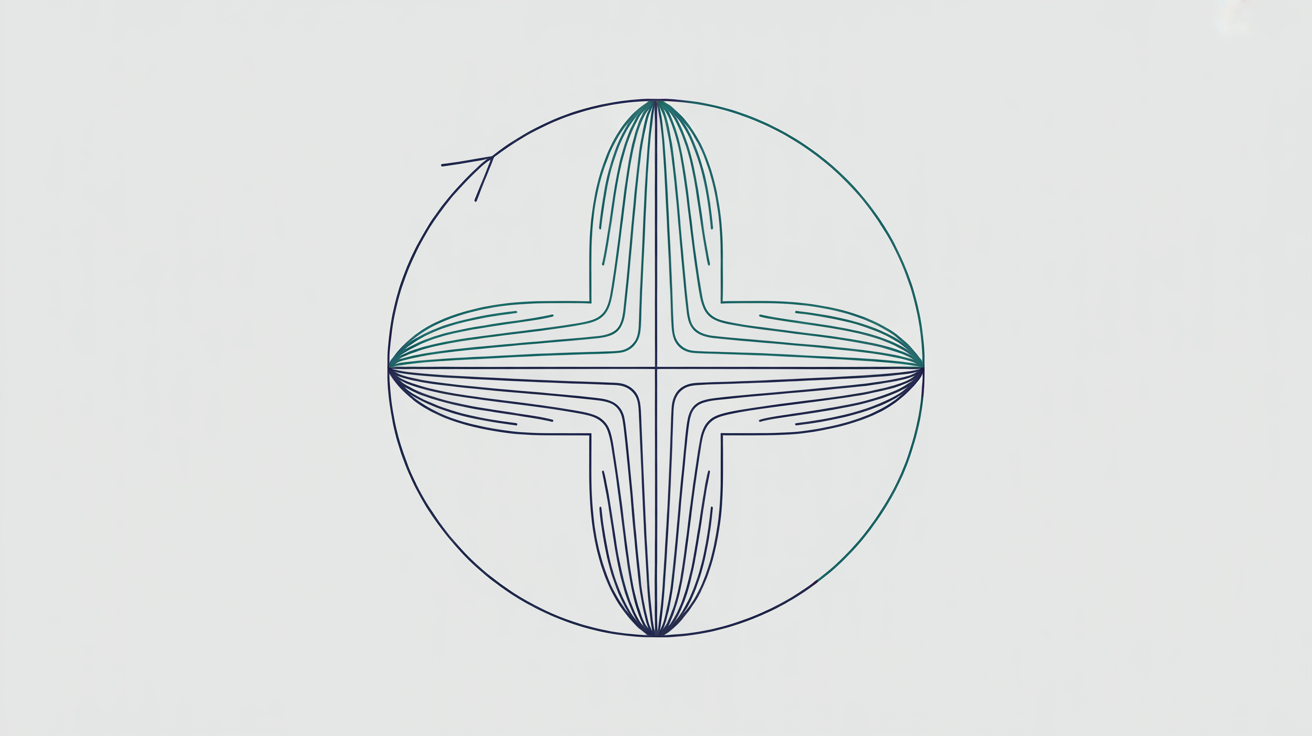
Nothing about the eye changed. The same correction is written two ways, and the two axes ninety degrees apart describe the same optical cross. Rewrite it on the Plus and Minus Cylinder Transposition Calculator rather than by hand; a transposition that moves the axis but not the sphere is the classic half-done rewrite, and it produces a prescription that is wrong in both notations.
Which axes can actually be ordered?
Fewer than can be refracted. Toric contact lens designs are made in a limited set of axes, commonly in 10-degree increments, and the refracted axis is rounded into that set.
This is a manufacturing constraint rather than an optical one, and it is why an ordered axis and a refracted axis are not always identical. How fine the available set is varies by design, by material and by the toric range on offer — read what contact lenses are made of for why the material sits upstream of what exists to order at all. This site does not publish availability by brand.
The practical consequence is that a refracted axis of 073 will be ordered at the nearest available value, and the fitting question becomes whether the vision through that lens, measured on the eye, is acceptable. That is an over-refraction question, not an arithmetic one.
The mark on a toric lens is not the axis
A soft toric lens carries a rotation reference, and it is easy to mistake it for the axis.
According to Optician, Essential Contact Lens Practice 8: Soft Toric Contact Lens Fitting, the lens carries an orientation marking so the practitioner can assess how far it has rotated and whether that rotation is stable — and that page states plainly that the mark does not indicate the cylinder axis. It also records that manufacturers use a variety of marks, typically at the six o'clock position or at the three and nine o'clock positions.
Reading that mark and compensating an ordered axis for a stable rotation is one clinical action, and it lives on the Toric Contact Lens Calculator. This page stops at what the printed number means.
Starting contact lens parameters still require on-eye fit
An ordered axis is a starting parameter, not a prescription.
It is taken from a refraction, rounded into the axes a design offers, and it assumes the lens will settle where the design intends. Whether it does is visible only at the slit lamp, and whether the resulting vision is acceptable is visible only through an over-refraction.
Patient aside (Grade 8–9)
The axis number says which direction your astigmatism runs in. It is a direction, not a strength, so a bigger number is not a stronger prescription. Do not compare axis numbers between people, and do not copy an axis from your glasses onto a contact lens order.
Read Starting Contact Lens Parameters Are Not a Prescription for the bound that applies across this site. Convert spectacle prescription to contact lens parameters for power. Fit base curve and diameter on eye. Verify power with over-refraction after the trial lens on the Over-Refraction Calculator. Contact lens parameters at the corneal plane stay unfinished until that sequence is done.
Sources
Clinical claims on this page are attributed to the publications below.
- ODReference, Plus/Minus Cylinder Conversion— the transposition rules and the axis wrap: add 90 when the original axis is 90 or less, subtract 90 when it is greater, keeping the value within 001–180. Attributed identically on Plus and Minus Cylinder Transposition Calculator and Toric Contact Lens Calculator.
- Chadwick Optical, Transposition Calculator— the same axis wrap; an axis outside 001–180 is a transcription error rather than a new meridian.
- Optician, Essential Contact Lens Practice 8: Soft Toric Contact Lens Fitting— the orientation marking exists so rotation and its stability can be assessed, the mark does not indicate the cylinder axis, and manufacturers place marks typically at six o'clock or at three and nine o'clock.
- This site's conversion module — vertex compensation is applied by meridian and leaves the axis unchanged.
Published Last updated Report a correction